
Manufactured Housing Market Update – September 2026
September 2, 2026
Manufactured Housing in 2026: Durable Fundamentals Meet a Changing Capital Market
Manufactured housing (MH) continues to demonstrate why it remains one of CRE’s most closely watched property sectors.
Capright’s newly released Manufactured Housing Market Update examines first-half operating performance, rental-rate trends, capital allocation, implied cap rates, institutional ownership, and the key issues likely to shape the sector through the remainder of 2026.
The central takeaway: MH fundamentals remain durable, but the more interesting story is increasingly happening in capital markets and valuation.
Please enter your email to download the report
Manufactured Housing Fundamentals Remain Resilient
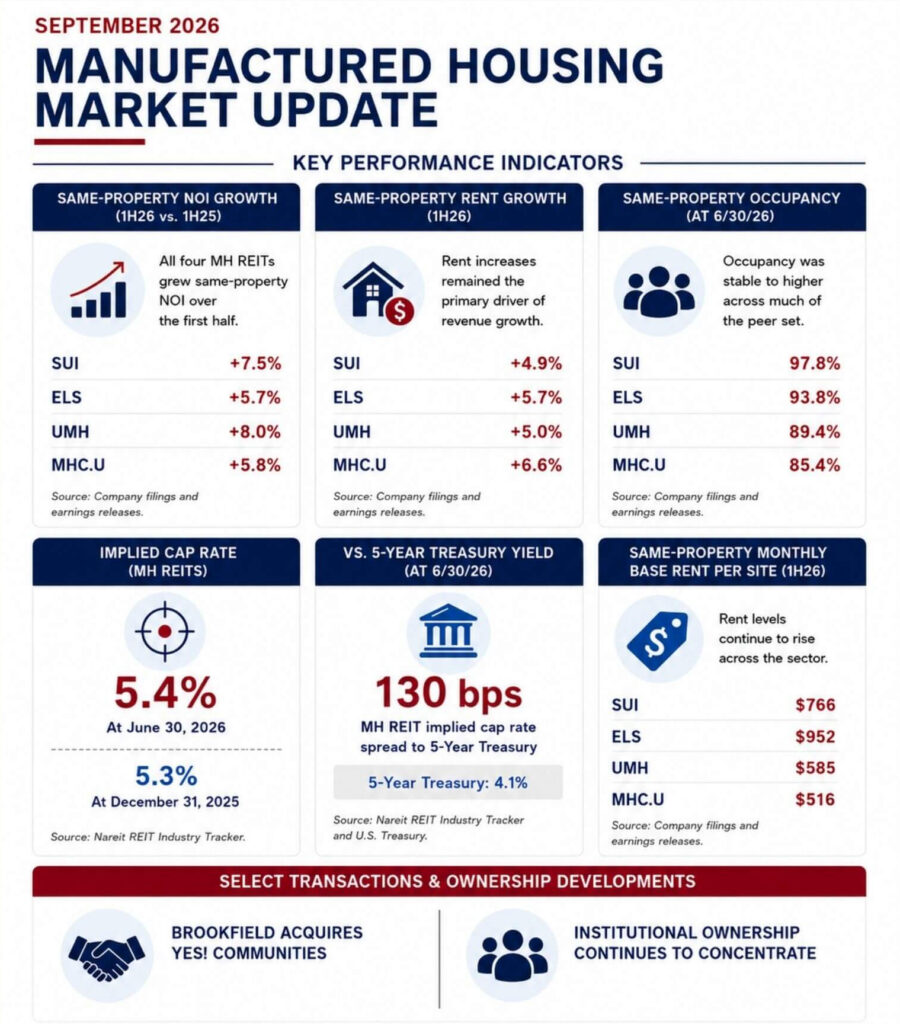
Results through 1H26 largely reinforced the sector’s position entering the year. All four public manufactured housing REITs analyzed by Capright reported same-property or same-community net operating income growth, while disclosed rent increases ranged from approximately 4.9% to 6.6%.
Performance varied across the peer group, but the underlying drivers remained consistent: rent growth continued to support revenue while occupancy and infill provided additional upside, particularly among operators with more room to increase utilization.
Occupancy remained particularly strong among the larger, more stabilized portfolios. Sun Communities reported same-property MH occupancy of 97.8%, while Equity LifeStyle Properties averaged 93.8% Core MH occupancy during the first half. UMH Properties reached 89.4% same-property occupancy, while Flagship Communities reached 85.4% same-community occupancy as of June 30.
Rent Growth Continues to Drive Performance
Pricing remains one of the clearest signs of strength in the MH market.
Across the four operators examined by Capright, disclosed rent growth remained clustered near 5%, although individual company measures are not directly comparable.
Sun Communities reported a 4.9% increase in MH monthly base rent, Equity LifeStyle Properties reported a 5.9% increase in Core MH monthly base rent per site, UMH Properties reported a 5.0% increase in same-property monthly rent per site, and Flagship Communities reported a 6.6% increase in weighted-average lot rent.
The persistence of rent growth, combined with generally stable or improving occupancy, continues to support property-level income durability.
But there is an important nuance.
At both Sun Communities and Equity LifeStyle Properties, recent increases to NOI guidance were driven primarily by lower expense assumptions rather than stronger revenue expectations. That makes expense performance an important variable to watch during 2H26.
Acquisition Activity Remains Selective
While operating fundamentals remain strong, external growth has been much more restrained.
Company-level capital deployment during the first half remained selective, with the larger platforms generally prioritizing organic expansion, balance-sheet management, portfolio simplification, and share repurchases rather than large-scale acquisitions.
That trend reinforces an important shift in the MH investment landscape: growth is increasingly being generated inside existing portfolios rather than through acquisitions.
At the same time, transaction data require careful interpretation. Sector-wide acquisition figures have been distorted by Sun Communities’ 2025 sale of Safe Harbor Marinas, illustrating why headline transaction statistics do not necessarily provide a clean picture of underlying manufactured housing investment activity.
Manufactured Housing Cap Rates and the Cost of Capital
Capital-market conditions present a more complicated picture.
The implied manufactured housing REIT cap rate stood at 5.4% as of June 30, 2026, essentially unchanged from 5.3% at year-end 2025. Over the same period, the five-year Treasury yield increased from 3.7% to 4.1%.
As a result, the spread between the implied MH REIT cap rate and the five-year Treasury narrowed from approximately 157 basis points to 130 basis points. The implied cap rate also remained below Moody’s Baa corporate bond yield.
For investors and valuation professionals, that creates an increasingly important question: How should public-market pricing be reconciled with private-market transaction evidence?
The answer remains complicated because relatively few MH portfolios are trading, limiting the private-market evidence available to establish a clear clearing level.
Institutional Capital Continues to Consolidate
One of the most significant developments covered in Capright’s update occurred outside the public REIT market.
In August 2026, Brookfield Asset Management completed its acquisition of YES! Communities, which the report identifies as the second-largest owner of MH sites in the United States. Post-closing descriptions place the platform at nearly 300 communities and more than 80,000 home sites across 23 states.
The transaction adds another dimension to an ownership landscape increasingly influenced by major institutional capital managers.
Brookfield’s position is particularly notable because, through YES! Communities and an existing joint-venture interest in RHP Properties, one manager now sits behind two of the sector’s largest private portfolios.
What to Watch in 2H26
Capright’s research identifies several questions that could determine how the MH market develops through year-end.
Expense behavior is particularly important. Sun Communities and Equity LifeStyle Properties are relying on lower expense-growth assumptions to support revised NOI expectations, while UMH entered the second half with expense growth above its normal budget range.
UMH’s ability to execute its rental-home strategy will also be worth watching, while Flagship’s challenge is translating continued occupancy improvement into stronger margins.
Ultimately, however, the biggest issue may be valuation.
MH enters 2H26 with its operating thesis largely intact. Rents continue to rise, occupancy remains healthy across much of the public REIT universe, and internal growth remains productive.
What is less settled is the relationship between public-market implied pricing, fixed-income alternatives, and the limited private-market transaction evidence available to valuers and investors.
📬 Let’s Talk
At Capright, we are uniquely positioned to support institutional investors, operators, and developers navigating this evolving environment. As an independent valuation and advisory firm, we provide clarity, accuracy, and confidence, especially where the stakes are highest.
If you’d like to discuss the findings or need support with your commercial real estate valuation or strategy, reach out to:


Process Lead
📧 [email protected]
🔗 Connect on LinkedIn