
Self-Storage REIT Update – October 2026
October 12, 2026
Self-Storage REIT Market Update: Stabilizing Fundamentals, Rental Rate Pressures, and Investment Trends in 2026
Capright’s Self-Storage REIT Update examines improving occupancy, slowing development activity, rental rate trends, and the challenges shaping the outlook for self-storage investors.
The U.S. self-storage market is showing early signs of stabilization after several years of supply pressure, shifting demand patterns, and declining rental rates. While challenges remain, improving tenant retention, a shrinking development pipeline, and more disciplined operating strategies are creating opportunities for the sector to regain momentum.
Capright’s latest Self-Storage REIT Update provides an in-depth analysis of the industry’s performance through 2Q26, highlighting key operating metrics, acquisition activity, rental rate trends, and the factors influencing self-storage property valuations.
Please enter your email to download the report
Self-Storage Occupancy Improves as Supply Growth Slows
One of the most encouraging developments in the self-storage sector is the improvement in occupancy.
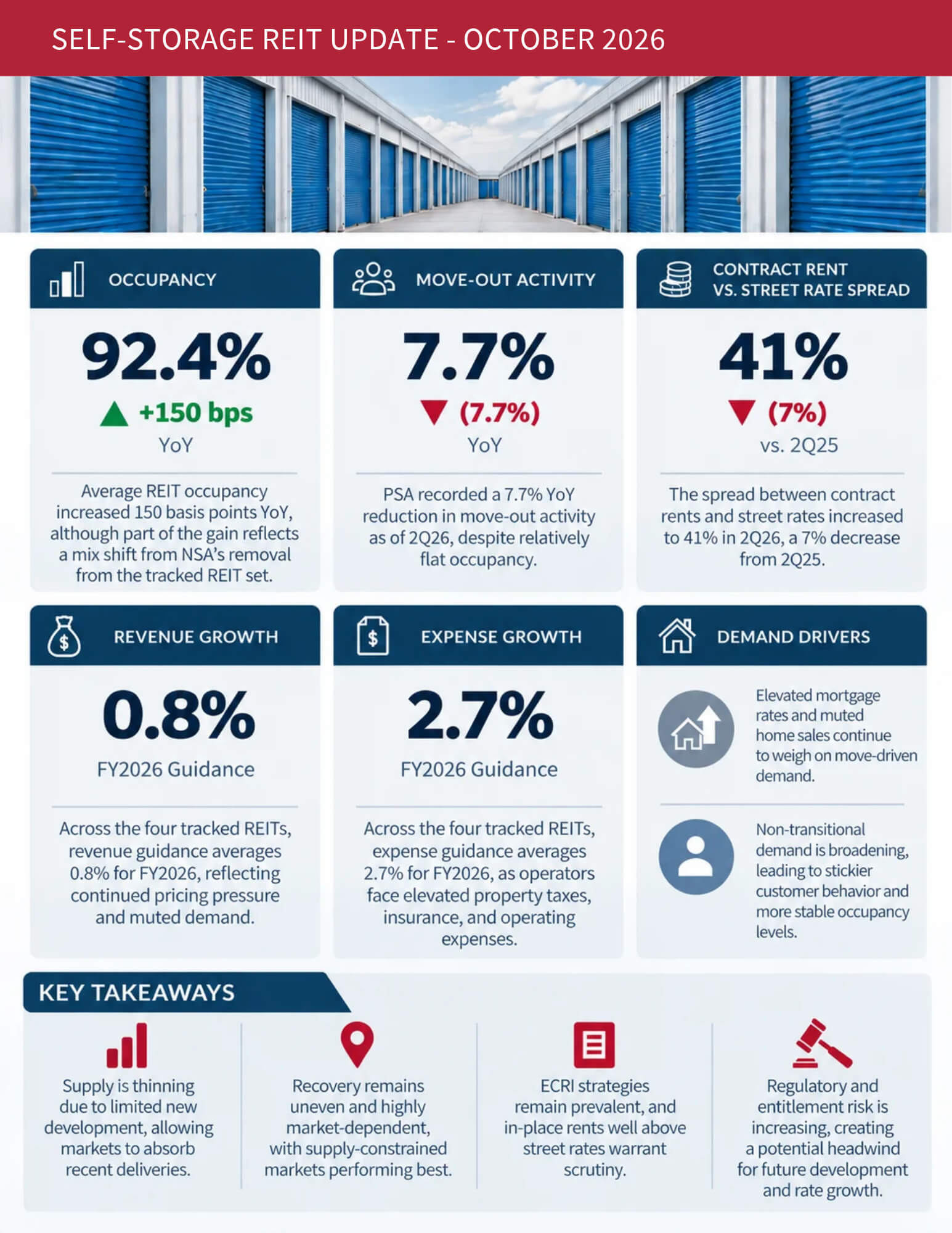
According to Capright’s research, average occupancy across the four tracked self-storage REITs reached 92.4% in 2Q26, representing an increase of 150 basis points YoY and 100 basis points QoQ. While some of this improvement reflects changes in the tracked REIT composition following Public Storage’s acquisition of National Storage Affiliates, the results also point to a more stable operating environment.
Tenant retention is another positive indicator. Public Storage reported a 7.7% YoY reduction in move-out activity, suggesting that customers are keeping their storage units longer.
At the same time, higher construction costs, constrained development financing, and extended lease-up periods are discouraging new self-storage development. As the supply pipeline contracts, existing facilities may benefit from reduced competition and improved pricing power.
However, recovery remains highly market-dependent, with supply-constrained markets generally outperforming areas that experienced significant recent development.
Self-Storage Rental Rates Remain Under Pressure
Despite improving occupancy, rental rate performance continues to present challenges for self-storage operators.
Capright’s analysis found that the spread between ECRIs and advertised street rates at Public Storage reached 41% in 2Q26, compared with just 11% in early 2020.
This widening gap reflects an industry strategy of offering discounted rates to attract new customers while implementing ECRIs to support revenue growth.
Although this approach has historically been effective, the growing difference between contract and street rates introduces potential tenant retention risks, particularly in markets with elevated competition.
Encouragingly, the spread narrowed for the second consecutive quarter in 2Q26, suggesting early signs of street-rate stabilization.
Operating Expenses Continue to Challenge Self-Storage REIT Performance
While occupancy is improving, rising operating expenses remain a significant concern for the sector.
Based on FY2026 guidance from the four tracked REITs, Capright’s report highlights:
- 0.8% average revenue growth guidance
- 2.7% average expense growth guidance
- Continued pressure on net operating income (NOI)
Property taxes, insurance, and other operating costs continue to outpace projected revenue growth, placing additional emphasis on expense management and operational efficiency.
These challenges also highlight the importance of accurate self-storage property tax assessments.
For institutional owners, ensuring that property valuations appropriately distinguish taxable real estate from goodwill and other intangible assets, where applicable, can help identify potential opportunities to reduce property tax burdens and protect operating margins.
Self-Storage Investment Activity Remains Selective
Transaction activity in the self-storage sector has remained subdued amid capital markets uncertainty, with nationwide net acquisition activity totaling approximately $1.2B in 2Q26.
Nevertheless, institutional investors continue to demonstrate interest in high-quality self-storage assets, particularly properties located in supply-constrained markets with stable occupancy and predictable cash flow.
One of the industry’s most significant transactions was Public Storage’s approximately $10.5B acquisition of National Storage Affiliates, which closed in July 2026.
The transaction underscores the continued importance of scale, operating efficiencies, and strategic portfolio positioning in the self-storage industry.
As the market evolves, investors are expected to remain selective, prioritizing assets with favorable supply-demand dynamics, sustainable rental growth, and well-supported underwriting assumptions.
Self-Storage Market Outlook: What Investors Should Watch
Looking ahead, Capright’s research identifies several trends likely to influence self-storage REIT performance and commercial real estate investment decisions.
Supply constraints may support recovery. A slowing construction pipeline should allow markets to absorb recently delivered inventory and gradually strengthen pricing power.
Tenant retention is becoming increasingly important. Longer customer stays and expanding non-transitional storage demand may provide greater stability in occupancy and revenue.
Market selection remains critical. Supply-constrained markets generally offer stronger near-term fundamentals, while some Sunbelt markets continue to face oversupply and rental rate competition.
Expense management will remain a priority. Operators must balance rental growth strategies with elevated property taxes, insurance costs, and other operating expenses.
Technology is reshaping operations. Advanced pricing tools, automation, and AI-enabled analytics are helping operators improve revenue management and control costs.
Although near-term challenges persist, the sector’s long-term demand drivers and institutional appeal remain intact.
📬 Let’s Talk
At Capright, we are uniquely positioned to support institutional investors, operators, and developers navigating this evolving environment. As an independent valuation and advisory firm, we provide clarity, accuracy, and confidence, especially where the stakes are highest.
If you’d like to discuss the findings or need support with your commercial real estate valuation or strategy, reach out to:


Principal
📧 [email protected]
🔗 Connect on LinkedIn