
Student Housing Market Update – September 2026
September 23, 2026
Student Housing in 2026: Demand Is Shifting, Not Disappearing
The student housing market is entering a new phase.
The long-anticipated demographic cliff is beginning to influence higher education, but its impact is far from uniform. Instead of simply reducing demand nationwide, demographic changes are redistributing student housing demand toward larger universities, stronger enrollment markets and institutions with national reach.
Capright’s new Student Housing Market Update examines what these shifts mean for student housing owners, investors, developers and valuation professionals.
Please enter your email to download the report
Student Housing Fundamentals Remain Resilient
Despite demographic headwinds, several key indicators point to continued strength in the sector.
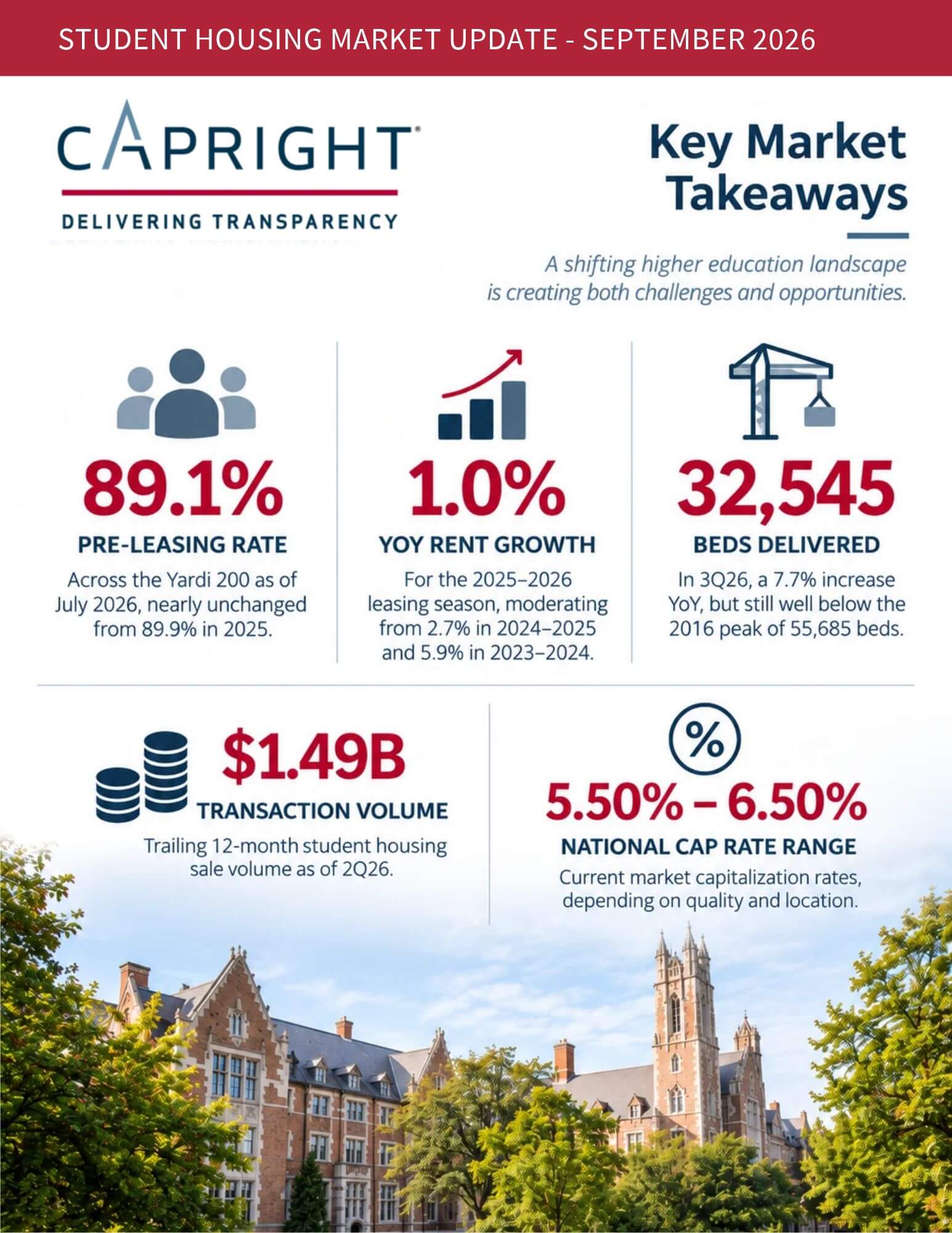
As of July 2026, pre-leasing across the Yardi 200 stood at 89.1%, compared with 89.9% at the same point last year. YoY rent growth remained positive at 1.0%, although it has moderated from the stronger increases recorded in previous leasing seasons.
New supply also remains measured relative to historical levels. Student housing deliveries totaled 32,545 beds in 3Q26, up 7.7% year over year but still well below the 2016 peak of 55,685 beds.
The “Demographic Cliff” Is Creating Winners and Losers
One of the most important trends isn’t simply declining demographics, it’s where students are choosing to enroll.
Smaller, tuition-dependent colleges, particularly in the Midwest and Northeast, are facing greater pressure. Meanwhile, many large universities in the South continue to benefit from population growth, affordability and their ability to attract students from outside their immediate regions. Large, nationally recognized universities in the Midwest and Northeast are also continuing to grow enrollment despite regional demographic challenges.
That distinction matters for student housing.
Construction activity is increasingly concentrated near universities with strong enrollment growth. The report highlights substantial development pipelines around Florida State University, Arizona State University, the University of South Carolina, the University of Wisconsin–Madison, the University of Michigan, Purdue University and Texas A&M.
Student Housing Investment Activity Is Picking Up
Capital markets are also showing signs of renewed activity.
Trailing 12-month student housing transaction volume reached $1.49B as of 2Q26, representing a 22% increase from the prior quarter, although volume remained 21% below the year-ago level. Current student housing capitalization rates generally range from 5.50% to 6.50% nationally, depending on property quality and location.
Large transactions continue to demonstrate institutional interest in the sector. In May 2026, a 12-property, 7,578-bed portfolio sold to a joint venture between Ares Management and The Scion Group for $910M, or approximately $120,084 per bed.
What Does This Mean for Student Housing Investors?
The story heading into the 2026/2027 academic year is increasingly one of market selection.
Enrollment trends, university strength, geographic migration, affordability, development pipelines and competitive supply are becoming even more important when evaluating individual student housing assets.
For owners and investors positioned near large universities with growing enrollment, Capright’s research indicates that fundamentals remain sound and the competitive supply environment remains favorable.
📬 Let’s Talk
At Capright, we are uniquely positioned to support institutional investors, operators, and developers navigating this evolving environment. As an independent valuation and advisory firm, we provide clarity, accuracy, and confidence, especially where the stakes are highest.