
Single-Family Rental REIT Update – October 2026
October 5, 2026
Single-Family Rental REITs Enter a New Phase: Key Takeaways from Capright’s SFR Market Update
The single-family rental (SFR) sector continues to evolve as improving leasing fundamentals, shifting capital allocation strategies, changing supply dynamics, and a new regulatory environment reshape the outlook for institutional owners and investors.
Capright’s latest Single-Family Rental REIT Update examines second-quarter results from the public SFR REITs, private-market activity, rental trends, institutional portfolios, and the factors likely to shape the sector heading into 2027.
Please enter your email to download the report
Leasing Fundamentals Are Improving
One of the clearest positive developments in 2Q26 was the return of positive new lease spreads at both public SFR REITs.
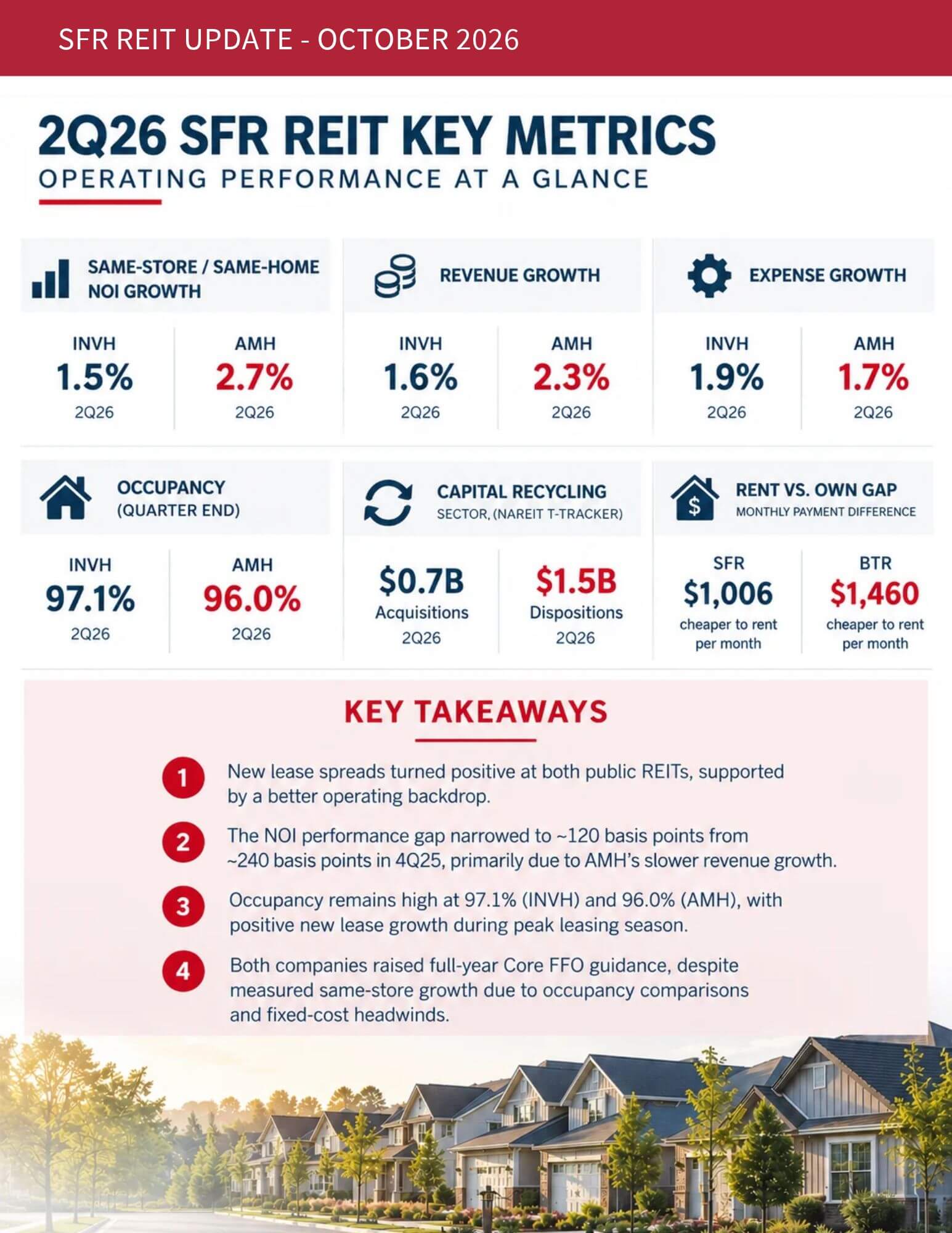
Invitation Homes (INVH) reported new lease growth of 1.1%, while American Homes 4 Rent (AMH) reported 1.4%. Blended lease growth reached 2.7% for both companies, a meaningful improvement from late 2025, when new lease spreads had fallen to -4.1% at INVH and -0.3% at AMH.
Occupancy also remained healthy, finishing the second quarter at 97.1% for INVH and 96.0% for AMH. While same-store growth remains measured, the combination of high occupancy and improving new lease pricing provides a stronger operating backdrop entering the second half of the year.
Capital Recycling Takes Center Stage
Perhaps the more important story, however, is not rent growth, it is capital allocation.
Both public REITs sold more homes than they added to their wholly owned portfolios during the quarter, redirecting capital toward development and share repurchases. Sector-level data showed approximately $0.7B of acquisitions compared with $1.5B of dispositions in 2Q26, representing the largest net-selling quarter in the series covered by the report.
INVH, for example, acquired 196 wholly owned homes from builders for $74M while selling 657 homes for $309M. The company also repurchased $100M of stock during the quarter. Management highlighted the relative-value opportunity created by the gap between private home values and public share prices.
This dynamic is changing the traditional SFR growth model. Rather than simply aggregating more homes, public operators are increasingly evaluating where each dollar of capital can generate the strongest return, whether through development, portfolio acquisitions, construction lending, or public equity.
Renting Remains Significantly Cheaper Than Owning
Affordability continues to support demand for single-family rentals.
Recent data cited in Capright’s update indicates that the average SFR home was approximately $1,006 per month cheaper to rent than to own, while build-to-rent (BTR) homes were approximately $1,460 per month cheaper. At the same time, scattered-site rent growth remained relatively modest at approximately 1.5% YoY, while BTR rent growth was roughly flat.
The result is an important distinction for investors and valuers: strong demand does not necessarily translate immediately into strong pricing power. Local supply conditions remain critical.
SFR Performance Is Increasingly Market-Specific
The latest results reinforce that there is no single national SFR story.
Midwest and select Western markets remain among the stronger operating environments, supported by limited new institutional supply. Seattle, Boise, and Salt Lake City were cited at approximately 96%–97% occupancy.
Meanwhile, Atlanta continues to experience muted rate growth, while Tampa, Orlando, and Phoenix are still absorbing supply from recent years. Encouragingly, supply pressure is beginning to ease in several of these markets, but the data does not yet indicate a broad Sun Belt rebound.
For valuation and underwriting, that divergence makes market-level analysis increasingly important.
Private-Market Institutional Exposure Continues to Expand
Institutional private-market exposure to SFR also continues to deepen.
As of 2Q26, NCREIF funds reported $9.70B of SFR holdings across 311 properties, compared with $7.42B across 251 properties one year earlier. That represents a 30.7% YoY increase in reported market value and a 23.9% increase in property count.
Importantly, Capright notes that these figures should not be interpreted simply as property appreciation. New contributors, acquisitions, and portfolio reclassifications can materially affect the NCREIF series. Instead, the increase illustrates the continued expansion of the institutional reporting base for SFR.
What Should SFR Investors Watch Heading Into 2027?
Several questions will help determine the direction of the sector over the coming year: whether positive new lease spreads persist through the slower leasing season; how quickly Atlanta, Tampa, Orlando, and Phoenix absorb recent supply; how private portfolio pricing evolves; whether property-tax growth offsets easing insurance and controllable expense pressure; and how much portfolio consolidation occurs under the sector’s changing regulatory framework.
The broader takeaway from 2Q26 is that the public SFR REITs entered the second half of the year with improving leasing fundamentals, but capital allocation may be the more consequential story.
As mature homes are sold, development pipelines expand, and companies evaluate the relative value of private assets versus public shares, SFR strategies are becoming increasingly selective. At the same time, a substantial rent-versus-own affordability gap continues to underpin demand even as pricing power varies considerably by market.
For investors, lenders, owners, and valuation professionals, understanding those differences will be essential as the sector moves into 2027.
📬 Let’s Talk
At Capright, we are uniquely positioned to support institutional investors, operators, and developers navigating this evolving environment. As an independent valuation and advisory firm, we provide clarity, accuracy, and confidence, especially where the stakes are highest.
If you’d like to discuss the findings or need support with your commercial real estate valuation or strategy, reach out to:

Principal
📧 [email protected]
🔗 Connect on LinkedIn