
Hotels with David Fuller – November 2026
November 23, 2026
Hotel REIT Outlook 2026: Rising Operating Costs and Interest Rates Challenge Hotel Valuations
On the Spot with Steve Williams and David Fuller
Capright’s David Fuller discusses the latest Hotel REIT Gross Asset Value Index, the factors driving hotel performance, and what investors can expect heading into 2027.
The U.S. hotel industry entered 2Q26 with improving performance, supported by stronger revenues, increased net operating income (NOI), and declining capitalization rates. However, rising operating expenses, interest rate pressures, and shifting demand trends could challenge hotel valuations heading into 2027.
In the latest episode of Capright’s On the Spot podcast, host Steve Williams sits down with David Fuller to discuss findings from the firm’s latest Hotel REIT Gross Asset Value Index and explore the economic factors shaping the outlook for hotel real estate investment trusts (REITs).
While recent performance has been encouraging, David explains why the industry’s positive momentum may face increasing headwinds in the months ahead.
Hotel REIT Valuations Improve in 2H26
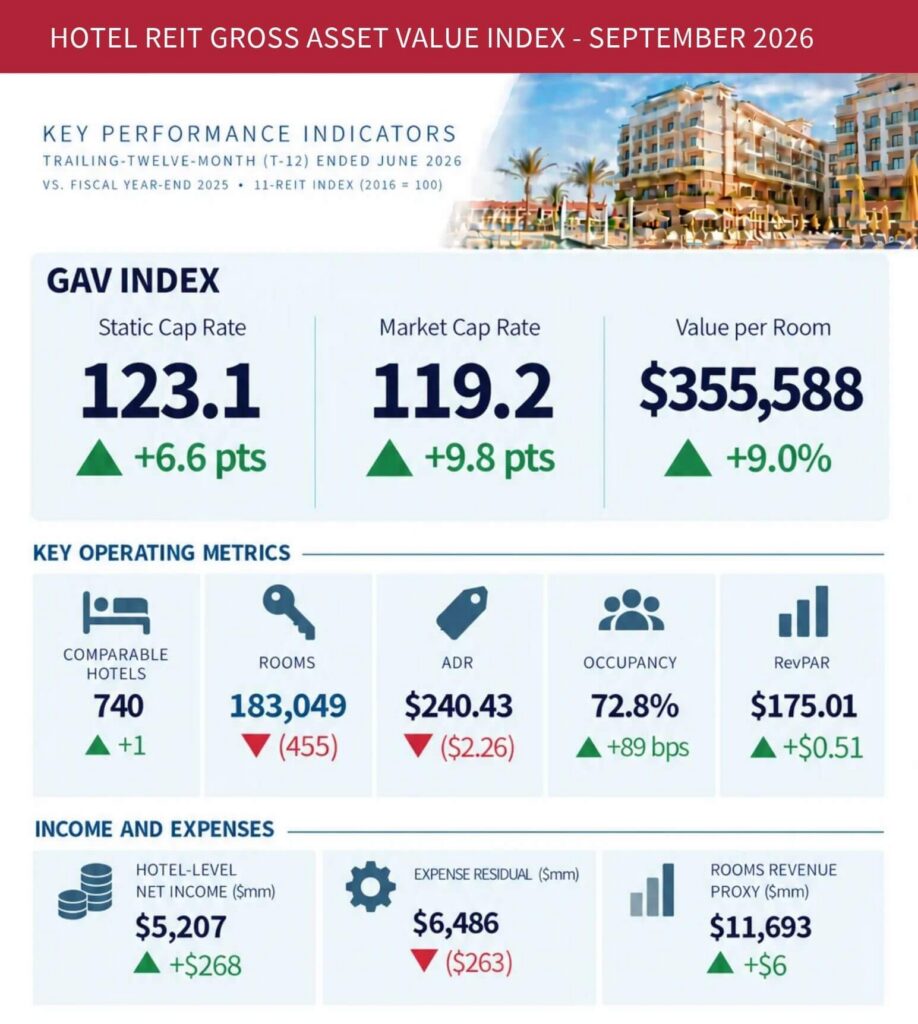
Capright’s latest Hotel REIT GAV Index reflects an improvement in hotel valuations, driven by stronger top-line performance and declining capitalization rates.
According to David, these results were consistent with expectations outlined in previous reports.
“We saw some uplift on the top line as well as a decrease in capitalization rates, leading to an increase in value over the last period that we had tracked,” David explains.
The combination of revenue growth, improved operating performance, and capitalization rate compression helped strengthen the Hotel REIT Index entering 2H26.
However, the sustainability of these gains will depend on how effectively hotel operators manage expenses and navigate changing capital market conditions.
Rising Hotel Operating Costs Threaten Net Operating Income
Despite recent improvements in hotel revenue and NOI, operating expenses remain a growing concern for the hospitality sector.
David identifies rising energy costs as a significant challenge for hotel owners and operators. Higher energy prices directly affect utility expenses while also increasing the costs of essential supplies used in housekeeping and property maintenance.
These pressures could make it increasingly difficult for hotel operators to translate revenue growth into sustained profitability.
“The combination is going to really have a downward pressure on NOI over the next six months or so,” David notes.
For hotel investors, this creates an important distinction between revenue growth and actual asset performance. Even when occupancy and room revenues remain healthy, increasing expenses can erode operating margins and limit property value appreciation.
As a result, expense management and NOI preservation will remain critical considerations for hotel owners and investors heading into 2027.
How Interest Rates and Capitalization Rates Affect Hotel Values
Beyond operating expenses, the interest rate environment presents another potential challenge for hotel real estate valuations.
Although declining capitalization rates contributed to recent gains in Capright’s Hotel REIT GAV Index, David cautions that continued interest rate pressure could reverse some of that improvement.
Higher interest rates can place upward pressure on capitalization rates, potentially reducing hotel property values even when operating performance remains relatively strong.
David anticipates that this dynamic could lead to lower hotel valuations on a per-room basis, putting downward pressure on the Hotel REIT GAV Index in upcoming reporting periods.
This relationship underscores the importance of evaluating hotel investments through both operational and capital market perspectives.
While hotel revenues and NOI are fundamental drivers of value, shifts in capitalization rates can materially influence asset valuations and overall investment performance.
Hotel Demand Outlook: What Happens After the 2026 FIFA World Cup?
Looking ahead, David remains cautiously optimistic about hotel revenue performance through the remainder of 2026 and into 2027.
One important consideration is the impact of the 2026 FIFA World Cup, which provided a meaningful demand boost to several major U.S. hotel markets.
The international sporting event generated additional lodging demand in host cities, contributing to stronger top-line performance during 2026.
However, this demand catalyst will not repeat in 2027, potentially creating more challenging year-over-year comparisons for affected markets.
David expects hotel revenue growth to remain positive but suggests that the pace of improvement could moderate.
Other major events and market-specific demand drivers may help support performance, but the absence of the World Cup’s extraordinary demand contribution could limit the industry’s ability to replicate its recent growth.
For hotel investors, understanding these temporary demand influences will be essential when evaluating future performance and forecasting revenue trends.
Hotel Industry Outlook for 2027: Positive Growth, but Increasing Headwinds
The outlook for hotel real estate entering 2027 presents a mix of opportunities and challenges.
On the positive side, hotel revenue performance has remained strong, and continued top-line growth is expected. However, several factors could temper future valuation gains:
- Rising operating expenses: Higher energy, utility, housekeeping, and maintenance costs could pressure hotel NOI.
- Interest rate uncertainty: Elevated borrowing costs and upward capitalization rate pressure could negatively affect hotel property valuations.
- Moderating revenue growth: The absence of the 2026 World Cup demand boost could slow YoY growth in certain markets.
- Potential valuation adjustments: Changes in NOI and capitalization rates could reduce hotel values on a per-room basis.
Together, these trends suggest that while the hospitality sector may continue to experience revenue growth, maintaining profitability and preserving asset values could become increasingly challenging.
Capright’s Hotel REIT Gross Asset Value Index provides an important benchmark for monitoring these developments and understanding how changing market conditions influence hotel real estate valuations over time.
For a full breakdown of the latest trends and insights, check out our Hotel REIT Gross Asset Value Index:
Please enter your email to download the report
📬 Let’s Talk
At Capright, we are uniquely positioned to support institutional investors, operators, and developers navigating this evolving environment. As an independent valuation and advisory firm, we provide clarity, accuracy, and confidence, especially where the stakes are highest.

Managing Director
📧 [email protected]
🔗 Connect on LinkedIn

Non-Executive Director
📧 [email protected]
🔗 Connect on LinkedIn