
Student Housing with Jonathan Rivera – November 2026
November 9, 2026
Student Housing Market Outlook 2026: Navigating Demographic Shifts, Cap Rates, and Investment Opportunities
On the Spot with Steve Williams and Jonathan Rivera
Capright’s Jonathan Rivera joins On the Spot to discuss the evolving student housing market, the impact of shifting enrollment demographics, and why the sector continues to demonstrate resilience despite economic uncertainty.
The student housing market is entering a period of demographic transition, raising questions about future enrollment trends, investment performance, and long-term demand. While declining numbers of high school graduates and uncertainty surrounding interest rates present challenges, the outlook for student housing real estate remains more nuanced than headlines might suggest.
In the latest episode of Capright’s On the Spot podcast, host Steve Williams welcomes Jonathan Rivera, to discuss the findings of the firm’s recent Student Housing Market Update. Their conversation explores how demographic changes are reshaping demand, why certain universities are better positioned than others, and what investors should consider as the market approaches 2027.
Demographic Shifts Are Reshaping Student Housing Demand
One of the most significant developments facing the student housing sector is a projected decline in the number of high school graduates following several years of growth.
This demographic shift, often referred to as the enrollment cliff, has been anticipated by higher education institutions for years. However, its impact is unlikely to be uniform across universities or student housing markets.
According to Jonathan, larger public universities, particularly those located in the Southern United States, are generally better positioned to withstand these demographic pressures.
Population growth in many Southern markets continues to support enrollment prospects, helping create a more favorable environment for student housing demand.
Smaller private institutions, particularly those in regions experiencing slower population growth, may face greater financial and enrollment challenges.
For student housing investors, these differences underscore the importance of evaluating individual university markets rather than treating the sector as a single, uniform investment category.
Can Alternative Education Programs Support University Enrollment?
As traditional college-age populations begin to decline, many higher education institutions are exploring strategies to diversify enrollment and strengthen their financial positions.
These initiatives include:
- Expanding adult and continuing education programs.
- Introducing career-oriented degree and certification programs.
- Increasing online and flexible learning opportunities.
- Attracting nontraditional students seeking professional development.
While these strategies may help smaller institutions maintain financial stability, Joanthan cautions that they do not necessarily translate into additional student housing demand.
Nontraditional students, including working adults and online learners, are generally less likely to live on campus or in nearby purpose-built student housing communities.
However, these programs can indirectly benefit existing student housing markets by helping universities remain financially viable.
A financially stable institution is better positioned to retain its traditional student population, supporting the long-term health of the surrounding student housing market.
For investors, the distinction between enrollment growth and housing demand remains critical. Not all increases in university enrollment generate corresponding demand for student housing accommodations.
Student Housing Cap Rates: What Investors Should Watch
Interest rates and capitalization rates remain central considerations for CRE investors, and the student housing sector is no exception.
Recent increases in U.S. Treasury yields have contributed to uncertainty in CRE capital markets, prompting some investors to delay transactions until borrowing costs and investment expectations stabilize.
Jonathan explains that although investors are closely monitoring these developments, the market has not yet demonstrated a clear, broad-based increase in student housing cap rates.
Instead, limited transaction activity has made it difficult to establish definitive pricing trends.
As transaction volume increases, additional price discovery should provide greater clarity on asset valuations and investor return expectations.
For student housing investors, several factors warrant continued attention:
- Treasury yields and financing costs: Changes in benchmark interest rates can influence investment underwriting and acquisition decisions.
- Transaction volume: Increased deal activity can provide stronger evidence of prevailing market pricing.
- Cap rate movements: Emerging transaction data will help determine whether investor return requirements are shifting.
- University fundamentals: Enrollment stability, institutional financial health, and local demographics remain essential to assessing individual assets.
Until transaction activity improves, investors should remain cautious about drawing broad conclusions from a limited number of sales.
Why Student Housing Remains a Resilient Real Estate Investment Sector
Despite demographic headwinds and capital market uncertainty, Joanthan maintains a constructive outlook for student housing investments.
His perspective centers on a fundamental characteristic of the asset class: student housing is, at its core, housing.
The United States continues to face significant housing supply challenges, creating a broader structural backdrop that may support residential real estate demand over the long term.
While student housing has unique demand drivers tied to university enrollment, academic calendars, and campus proximity, it also benefits from the fundamental need for residential accommodations.
For investors, this reinforces the importance of identifying markets with stable or growing student populations, strong university fundamentals, and favorable supply-and-demand conditions.
Rather than signaling widespread weakness across the sector, current demographic changes may lead to greater differentiation between student housing markets and investment opportunities.
Looking Ahead: Student Housing Investment Outlook for 2027
As the student housing market moves toward 2027, demographic trends, university financial stability, and capital market conditions will continue to shape investment strategies.
Large universities in growing population centers may remain relatively insulated from enrollment pressures, while smaller institutions could face more significant challenges.
Meanwhile, stabilization in interest rates and increased transaction activity could provide much-needed clarity on student housing valuations and cap rates.
Jonathan’s outlook suggests that although investors should remain attentive to these developments, the underlying fundamentals of student housing continue to support a generally positive long-term perspective.
For investors and other CRE stakeholders, understanding the relationship between enrollment demographics, university financial health, and local housing demand will be essential to navigating the sector’s next phase.
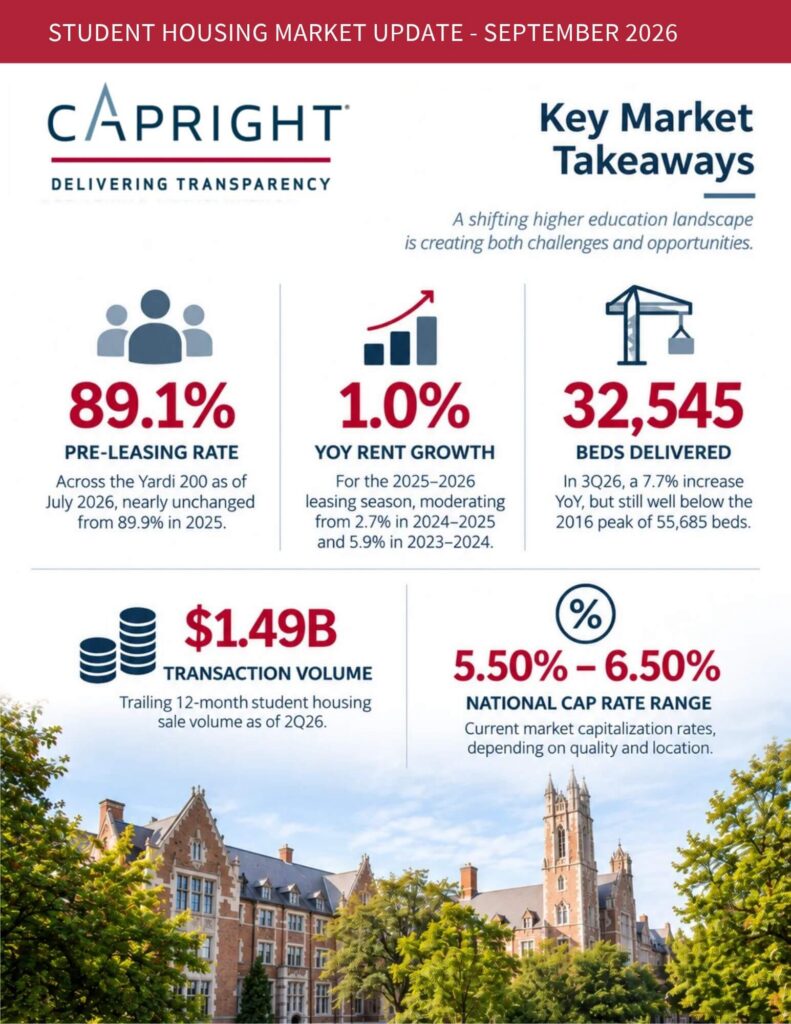
For a full breakdown of the latest trends and insights, check out our Student Housing Market Update:
Please enter your email to download the report
📬 Let’s Talk
At Capright, we are uniquely positioned to support institutional investors, operators, and developers navigating this evolving environment. As an independent valuation and advisory firm, we provide clarity, accuracy, and confidence, especially where the stakes are highest.


Non-Executive Director
📧 [email protected]
🔗 Connect on LinkedIn