
Industrial Outdoor Storage with Jonathan Gonzalez – November 2026
November 2, 2026
Industrial Outdoor Storage: How Institutional Investment Is Transforming the IOS Market
On the Spot with Steve Williams and Jonathan Gonzalez
Capright’s Jonathan Gonzalez joins the On the Spot podcast to discuss the growing institutional interest in IOS, the evolution of IOS valuations, and why property-specific characteristics matter more than ever.
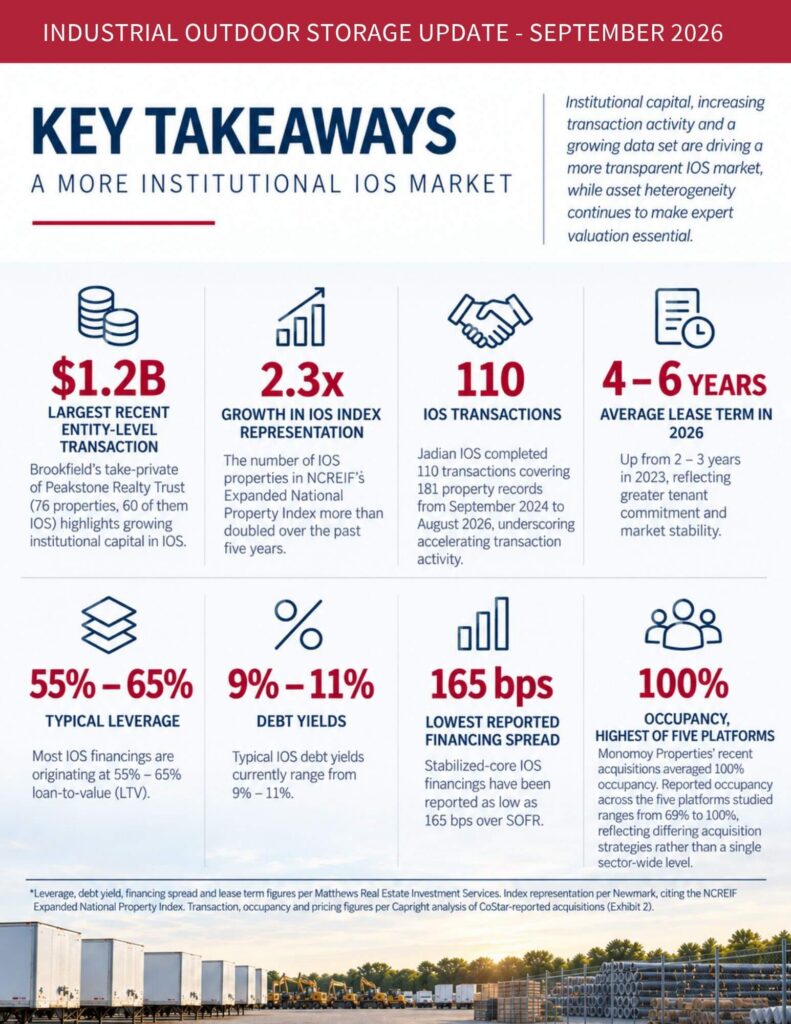
Industrial outdoor storage (IOS) is gaining momentum as an increasingly recognized CRE asset class. As institutional investors expand their presence in the sector, increased transaction activity, improved market data, and greater pricing transparency are helping reshape the IOS investment landscape.
But as the market matures, one critical challenge remains: How can investors accurately value industrial outdoor storage properties when no two sites are alike?
In the latest episode of Capright’s On the Spot podcast, host Steve Williams sits down with Jonathan Gonzalez to explore the impact of institutional capital on the IOS market and the complexities of valuing these highly specialized assets.
Institutional Capital Is Accelerating the Maturity of the IOS Market
The growing influx of institutional investment into IOS is creating opportunities for greater market sophistication and transparency.
As more institutional investors enter the sector, the market is experiencing several important developments:
- Increased transaction activity: More acquisitions and larger portfolio transactions are expanding the available pool of comparable sales data.
- Greater operational scale: Institutional ownership is encouraging more consistent property management and operating practices.
- Improved market intelligence: More operating data and timely reporting are helping investors better understand property performance.
- Standardized leasing practices: Increasingly consistent lease structures are supporting more meaningful comparisons across assets.
- Enhanced pricing transparency: A growing volume of transaction and operating data is providing additional insight into IOS property values.
“Greater pricing transparency helps IOS continue to mature as an asset class,” Jonathan explains.
These developments are helping establish a more informed investment environment, supporting institutional participation and the continued evolution of IOS as a distinct CRE sector.
Why IOS Valuation Requires More Than Price Per Acre
While increased transaction data is improving market transparency, valuing IOS properties remains complex.
Unlike more standardized CRE assets, IOS properties can differ significantly in their physical characteristics, permitted uses, and operational capabilities.
Consider two five-acre IOS sites located just a few miles apart. Although they may appear comparable based on location and acreage, their investment potential and underlying values could be dramatically different.
One property may feature favorable zoning, fully usable acreage, convenient access, and paved outdoor storage areas. The other may face environmental constraints, limitations on usable land, or restrictions on outdoor storage activities.
These differences can materially influence each property’s functionality, marketability, and value.
As Jonathan emphasizes, simply comparing transactions based on price per acre can overlook many of the factors that determine an IOS property’s actual worth.
For investors and lenders, understanding what makes each IOS asset unique is essential to making informed real estate decisions.
Turning IOS Market Data Into Meaningful Valuation Insights
As institutional investment increases the availability of IOS transaction and operating data, the ability to properly interpret that information becomes increasingly important.
More data does not automatically translate into more accurate valuations.
Effective IOS valuation requires careful analysis of the characteristics that distinguish one property from another, including zoning, site usability, access, surface conditions, and environmental limitations.
During the podcast, Jonathan explains how Capright analyzes extensive market data to develop property-specific valuations while identifying the key indicators that differentiate individual IOS assets.
This approach goes beyond broad market averages and traditional price-per-acre comparisons to provide a more complete understanding of an asset’s value.
For institutional investors, lenders, and property owners, these insights can support acquisition decisions, portfolio analysis, financing, and investment strategy.
What’s Next for IOS?
The increasing presence of institutional capital represents an important step in the evolution of the IOS market.
As transaction volumes grow, lease structures become more standardized, and market reporting improves, investors should gain access to increasingly sophisticated tools for evaluating IOS opportunities.
However, the sector’s inherent property-level differences will continue to make specialized valuation expertise essential.
The takeaway: Greater market transparency is helping IOS mature, but successful investment decisions still depend on understanding the unique characteristics and limitations of each property.
For a full breakdown of the latest trends and insights, check out our Industrial Outdoor Storage Update:
Please enter your email to download the report
📬 Let’s Talk
At Capright, we are uniquely positioned to support institutional investors, operators, and developers navigating this evolving environment. As an independent valuation and advisory firm, we provide clarity, accuracy, and confidence, especially where the stakes are highest.

Senior Associate
📧 [email protected]
🔗 Connect on LinkedIn

Non-Executive Director
📧 [email protected]
🔗 Connect on LinkedIn