
Student Housing Market Update – March 2026
March 16, 2026
Student Housing Market Outlook: Key Trends Shaping the Sector in 2026
The U.S. student housing market continues to evolve as shifting demographics, enrollment trends, and capital market conditions reshape the sector.
Enrollment Trends Continue to Support Student Housing Demand
Student housing demand remains closely tied to higher education enrollment. Recent data shows encouraging momentum.
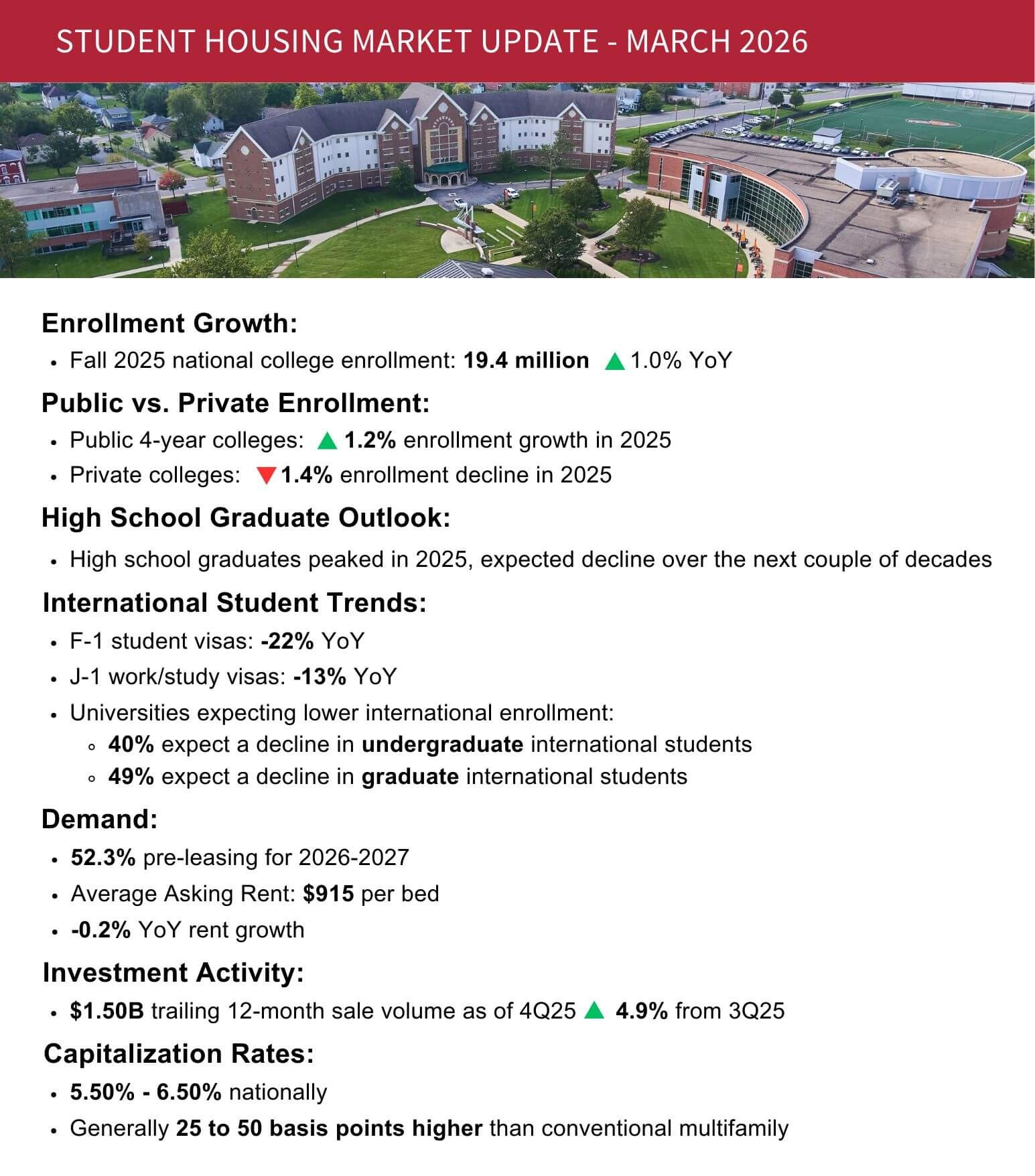
As of the Fall 2025 semester, total U.S. college enrollment reached 19.4 million students, marking a 1.0% YoY increase and the highest level since 2018.
However, enrollment trends are not uniform across institutions:
- Public four-year universities: enrollment increased 1.2% in 2025
- Private colleges: enrollment declined 1.4% in 2025
This divergence is creating a clear structural trend within the sector: demand is increasingly concentrated around large flagship public universities, particularly in growth regions such as the southern United States.
For investors, this reinforces the importance of university strength, enrollment growth, and institutional financial health when evaluating student housing opportunities.
Demographic Headwinds Are Emerging
Despite recent enrollment gains, long-term demographic shifts are beginning to appear.
The number of U.S. high school graduates peaked in 2025 and is expected to decline over the next several decades, driven by lower birth rates.
Importantly, this trend will not affect all regions equally:
- Western states are projected to see significant declines in high school graduates
- Southern states are expected to see modest growth
These regional differences are already influencing student housing development patterns, with new construction concentrated near universities experiencing sustained enrollment growth.
International Student Trends Create Additional Uncertainty
International students have historically been a critical driver of university enrollment and campus revenue.
However, recent policy changes have impacted student visa issuance:
- F-1 student visas declined 22% YoY
- J-1 work/study visas declined 13% YoY
As a result, many universities are anticipating potential enrollment declines among international students, adding another layer of uncertainty to the sector’s demand outlook.
Leasing Fundamentals Remain Stable but Rent Growth Has Slowed
Operational metrics across the student housing sector show mixed signals.
Recent leasing data indicates:
- 52.3% pre-leasing for the 2026–2027 academic year, up from 45.6% a year earlier
- Average asking rent: $915 per bed
- YoY rent growth: –0.2%
While rent growth has softened following several years of strong gains, the increase in pre-leasing activity suggests steady demand heading into the upcoming academic year.
New Supply Remains Constrained
Construction activity across the sector remains relatively modest compared to historical levels.
Approximately 30,000 student housing beds are expected to deliver in Fall 2026 across 37 campuses, slightly above the 26,000 beds delivered in 2025.
However, this remains well below the roughly 50,000 beds delivered annually during the prior decade, helping prevent significant oversupply in many markets.
Investment Activity and Cap Rates
Capital markets activity in the student housing sector remains steady.
Key investment metrics include:
- $1.50B in trailing 12-month sales volume as of 4Q25
- 5.50% – 6.50% national cap rate range
- Cap rates generally 25–50 basis points higher than conventional multifamily
These pricing dynamics reflect the unique risk profile of student housing, which is closely tied to the performance and stability of the universities they serve.
Please enter your email to download the report
📬 Let’s Talk
At Capright, we are uniquely positioned to support institutional investors, operators, and developers navigating this evolving environment. As an independent valuation and advisory firm, we provide clarity, accuracy, and confidence, especially where the stakes are highest.