
Manufactured Housing Market Update – April 2026
April 7, 2026
Manufactured Housing Remains a Pillar of Stability in CRE
In a CRE environment defined by capital discipline, shifting valuation dynamics, and selective investment activity, one sector continues to stand out for its durability: Manufactured Housing.
Capright’s latest Manufactured Housing Market Update – April 2026 delivers a data-driven look at why institutional capital continues to favor this asset class, and how the investment thesis is evolving.
Please enter your email to download the report
A Sector Built on Stability, and Now, Strategic Execution
Manufactured housing (MH) remains one of the most resilient segments in U.S. real estate, supported by:
- Consistent demand driven by affordability constraints
- Limited new supply
- High occupancy and tenant retention
- Predictable, recurring cash flow
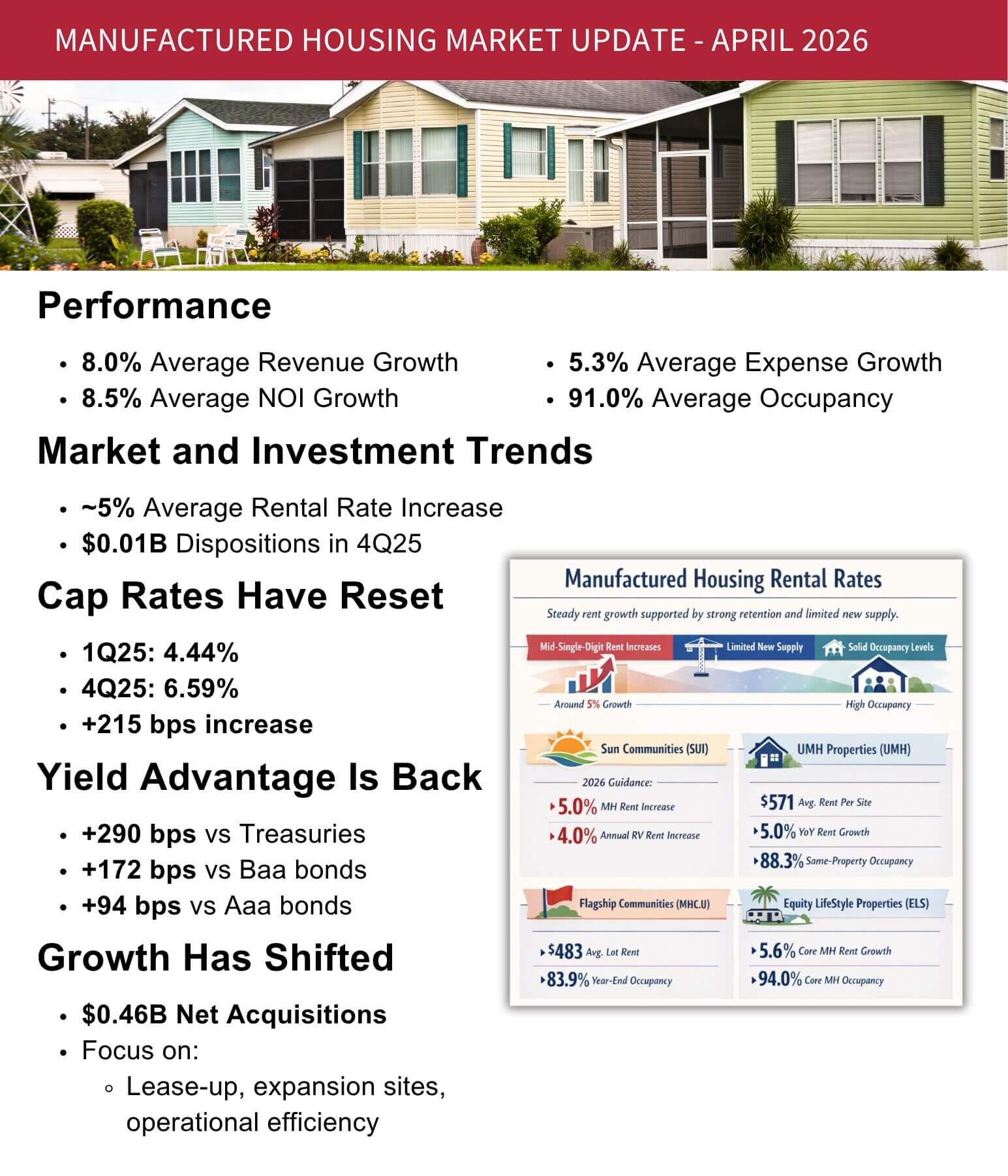
Public MH REITs delivered:
- 8.0% average revenue growth
- 8.5% NOI growth
- 91.0% average occupancy
But the story in 2026 is not just about stability. It’s about how returns are being generated.
Cap Rates Reset and Yield Advantage Returns
One of the most notable shifts is the repricing of risk and return.
- Implied cap rates increased from 4.44% (1Q25) to 6.59% (4Q25)
- Spreads widened to:
- +290 bps vs. Treasuries
- +172 bps vs. Baa bonds
- +94 bps vs. Aaa bonds
This reset has restored a meaningful yield premium, repositioning MH as a compelling income-focused allocation.
Investors are no longer relying on cap rate compression, but instead on income durability and operational performance.
Rent Growth Holds Firm, Without Breaking Demand
Despite macro pressures, MH operators continue to demonstrate pricing power:
- ~5% average rental rate increases across the sector
- Strong occupancy levels (often 90%+) supporting rent growth
- Revenue driven by both rate increases and occupancy gains
Larger, stabilized portfolios are leaning into annual rent growth, while smaller operators continue to unlock value through lease-up and infill strategies.
Capital Deployment: From Expansion to Optimization
The investment environment has shifted meaningfully:
- $0.46B in acquisitions vs. minimal dispositions
- Focus areas include:
- Lease-up strategies
- Expansion sites
- Operational efficiencies
Rather than broad portfolio growth, operators are prioritizing internal value creation and disciplined capital allocation.
Institutional Capital Still Expanding Its Footprint
MH continues to attract both:
- Public REIT platforms (e.g., large, diversified portfolios with scale advantages)
- Private institutional investors pursuing regional, value-add strategies
The sector remains highly fragmented, but institutional ownership is steadily increasing. This is driven by:
- Scalable operating models
- Access to capital
- Long-term demographic tailwinds
📬 Let’s Talk
At Capright, we are uniquely positioned to support institutional investors, operators, and developers navigating this evolving environment. As an independent valuation and advisory firm, we provide clarity, accuracy, and confidence, especially where the stakes are highest.
If you’d like to discuss the findings or need support with your Manufactured Housing valuation or strategy, reach out to:


Process Lead
📧 [email protected]
🔗 Connect on LinkedIn